What does a neighbourhood build when nobody sets a target?
A neighbourhood that only minimises cost fills its roofs with solar panels at today's prices, adds a small community battery and lands at 60% self-sufficiency by itself: 341 euros per home per year. Seasonal storage never enters the solution at any electricity price. The 90% neighbourhood costs 8,090 euros; the last thirty percentage points are a value choice worth over 7,700 euros per home per year.
A thought experiment I could measure
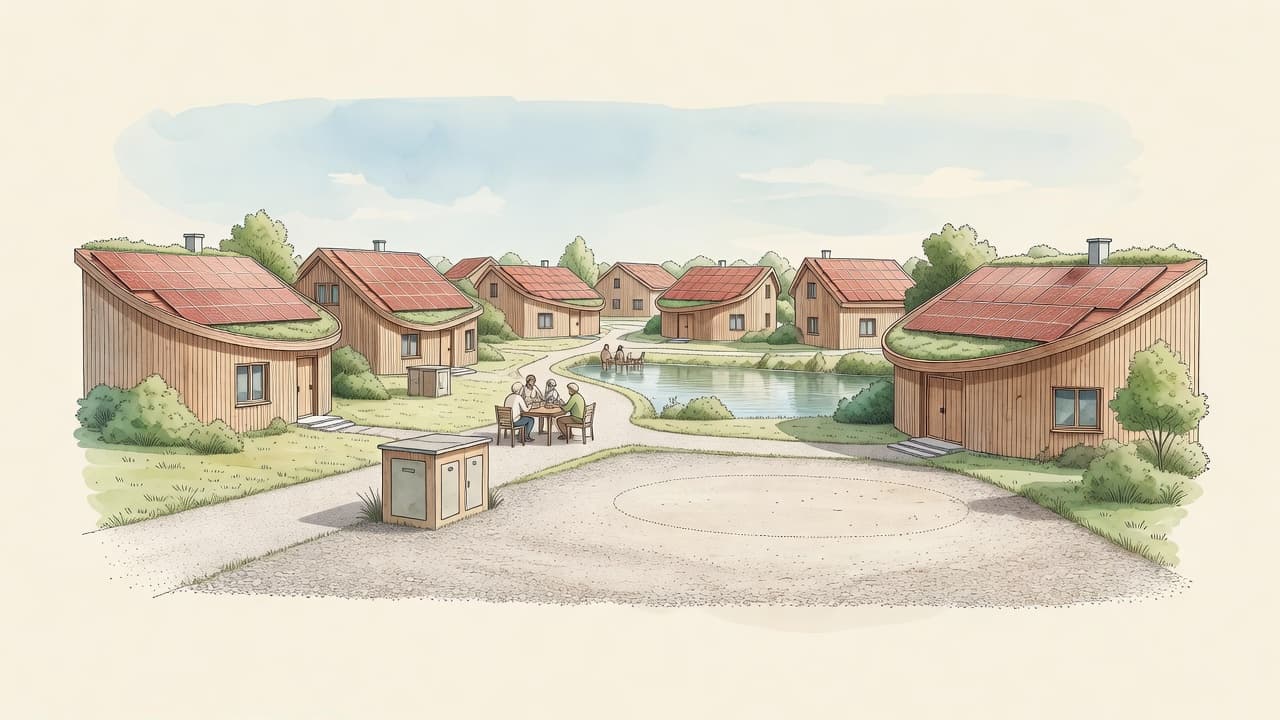
Image above: AI impression, not a construction drawing.
My end picture for 2045 contains a sentence I avoided testing for a long time: once energy is free, land, hours and location take over as the limits. The energy half of that sentence is a calculation, and that calculation I could run.
The setup: the same robust optimisation that sits behind the explorer, eight all-electric homes in Breda, three real weather years, but without a self-sufficiency requirement. No target. The only question to the model is what a neighbourhood builds when only cost counts, and I ask it at electricity prices from zero to four times the 2018 to 2022 series.
I expected a dull table. I got four findings that I now put next to every claim my own lab makes.
At free electricity nobody builds anything
At price zero the model picks no panel and no battery. Nothing. The neighbourhood is a grid customer and the only number that still matters is the kilowatt: an import peak of 13 kW without cars and 42 kW with, on a 55 kW connection.
For eight households that holds. But the peak scales linearly with households and the substation does not; in the Breda block where my neighbourhood sits, the surroundings ask for 96 MW and 69 is available. Free kilowatt-hours without kilowatts is an empty notion. The scarcity that remains is not only land, hours and location, but also the cable and the institution that builds substations.
From ten cents, the whole roof
Between 8 and 15 cents per kilowatt-hour it flips. At 8 cents the neighbourhood builds 3 kWp; at 15 cents every roof is full with 80 kWp. After that only the battery grows: 17, 53, 144 and 249 kWh at half, once, twice and four times today's price.
The self-sufficiency that follows by itself plateaus around 60 to 66 percent. And at four times the price it falls again, to 62%. The battery turns trader: import cheap, export dear, and the cable runs full all year. A high electricity price does not make a neighbourhood self-sufficient. It makes it more grid-intensive.
Seasonal storage never comes out of the sum
At no price does the model choose seasonal storage. Not even at four times today's. The store appears only once I impose a self-sufficiency requirement. The winter wall this lab log started with is therefore not an economic phenomenon. It is a choice.
And that choice has a price. The cost optimum costs 341 euros per home per year and reaches 60% in the harshest of the three weather years. The 90% neighbourhood costs 8,090 euros. Over 7,700 euros per home per year for the last thirty percentage points, at the storage price I call the honest one, 100 euros per kWh.
That number appeared nowhere on my own explorer. Its cost curve starts at 50% and is flat up to 60%, because the target does not bind there; the cost optimum was already on the curve, just without a name. Now it has one: the zero point. Every ambition is a surcharge above it. At 80% that is 1,090 euros per home per year. At 90%, 7,748 euros. I have not found a 90% claim, my own included, with that amount printed next to it. From now on it is.
What this rests on
The weakest points, for anyone who wants to attack this:
- The price "once" is the average of 2018, 2021 and 2022, and 2022 was the crisis year: 31 cents all-in. A normal year sits closer to half that. Read the table with half a step to the left.
- The sweep scales import and export together. A world with free import but paid export does not exist; the reverse does, and I have not run that variant.
- The model knows the weather a year ahead. The trading profit at two and four times the price is therefore an upper bound.
- The 7,700 euros hangs on the storage price of 100 euros per kWh. At 20 euros it is 1,900. That price tag falls with the learning curve of electrolysers and iron-air batteries, not with the electricity price.
This article is the mirror image of the winter wall and seasonal storage breaks the winter wall: the same neighbourhood, without the requirement. The full sweep is in the public lab log.