The number that does not exist
My crossover model leans on a parameter that exists nowhere in the literature: the learning curve of construction automation. The reconstructed band is 8 to 15% per doubling of automated volume, 10% central, and it is explicitly built to be refuted.
Two sprints, zero learning curves
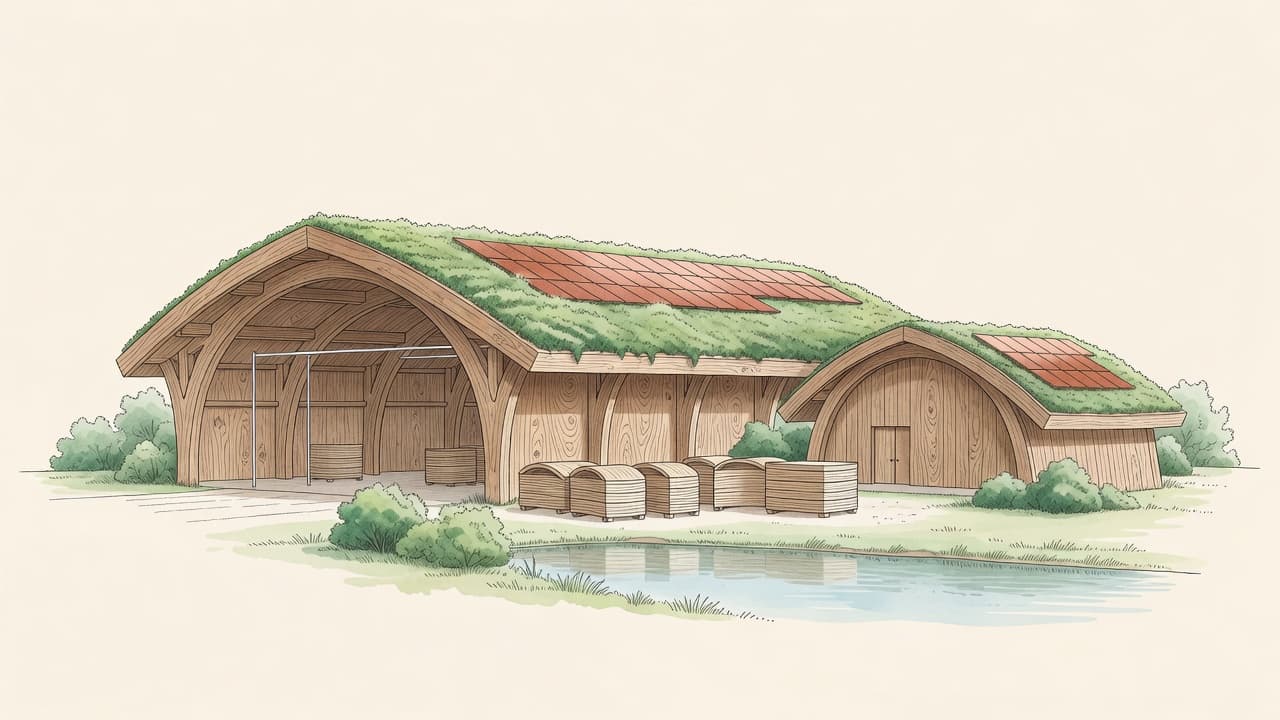
Image above: AI impression, not a construction drawing.
My crossover model, the question of when automated new construction becomes cheaper than renovation, leans on one parameter I could not find anywhere: the learning curve of construction automation. How much cheaper does factory-built construction get with every doubling of cumulative volume? Two deep-research sprints produced nothing. No study, no dataset, no consultant figure worthy of the name.
That leaves one route: construct the number yourself, with all sources open on the table, so everyone can see where it breaks.
Why you cannot find it
First the riddle: why does this curve not exist, while solar panels (roughly 20% per doubling) and batteries (18%) are textbook examples?
The answer is dilution. Of the total cost of a home, land and permit fees learn nothing at all, and materials barely. The part automation can grip, the automatable share of labour plus the robot system, is perhaps 20 to 25% of direct construction cost. Even a healthy 15% learning rate on that part is only 3 to 4% per doubling on the total price. That disappears under the measurement noise of business cycles, land prices and wage rounds. The curves do exist. Diluted.
The band and its adversaries
My reconstruction arrives at 8 to 15% cost decline per doubling of cumulative automated construction volume, with 10% as the central estimate, and it applies only to the automatable share. The best anchor is onshore wind, about 12%: a large object with a factory component and site-bound assembly, structurally the most construction-like success case.
The band's adversaries matter at least as much. Nuclear power has a negative learning curve: reactors got more expensive with every unit built. Katerra burned two billion dollars on the promise of factory construction and went bankrupt on the lack of repetition. And Japan has been building homes in factories for seventy years without prices ever falling; the efficiency became margin and quality, not cheaper houses.
For renovation I could reconstruct something, thanks to the Energiesprong programme: from 130,000 to 80,000 euros per home over roughly nine and a half doublings is 4 to 7% per doubling. My assumption that renovation captures only 30% of the automation potential turns out to be conservative rather than optimistic.
What this does to the crossover year
The consequence for the core question can now be stated sharply. A crossover before 2045 requires a learning rate of at least 8% and volume growth of at least 15% per year, sustained, without the sector getting stuck in the familiar pilot gap. Both sit inside the band. Neither is guaranteed.
The crossover years on the explorer, 2039 to beyond 2055 depending on ambition and scenario, were always a band and never a forecast. What is new is that this band now rests on a documented parameter band instead of a feeling.
What this rests on
- Not a single component of this band is a measured learning curve of construction robotics. It is a reconstruction from analogies and fragments, and that is how it should be read.
- The band is falsifiable, and that is its most important property: one published cost series of a robot platform or modular factory across three or more doublings that falls outside 4 to 20%, and it must be revised. I am actively looking for such series; 3D concrete printing cost per square metre against cumulative printed volume is the first candidate.
- If adoption stalls, the binding parameter is not the learning rate but the S-curve, and the whole story shifts.
- The full dossier, with over thirty labelled sources, is in the lab repository.