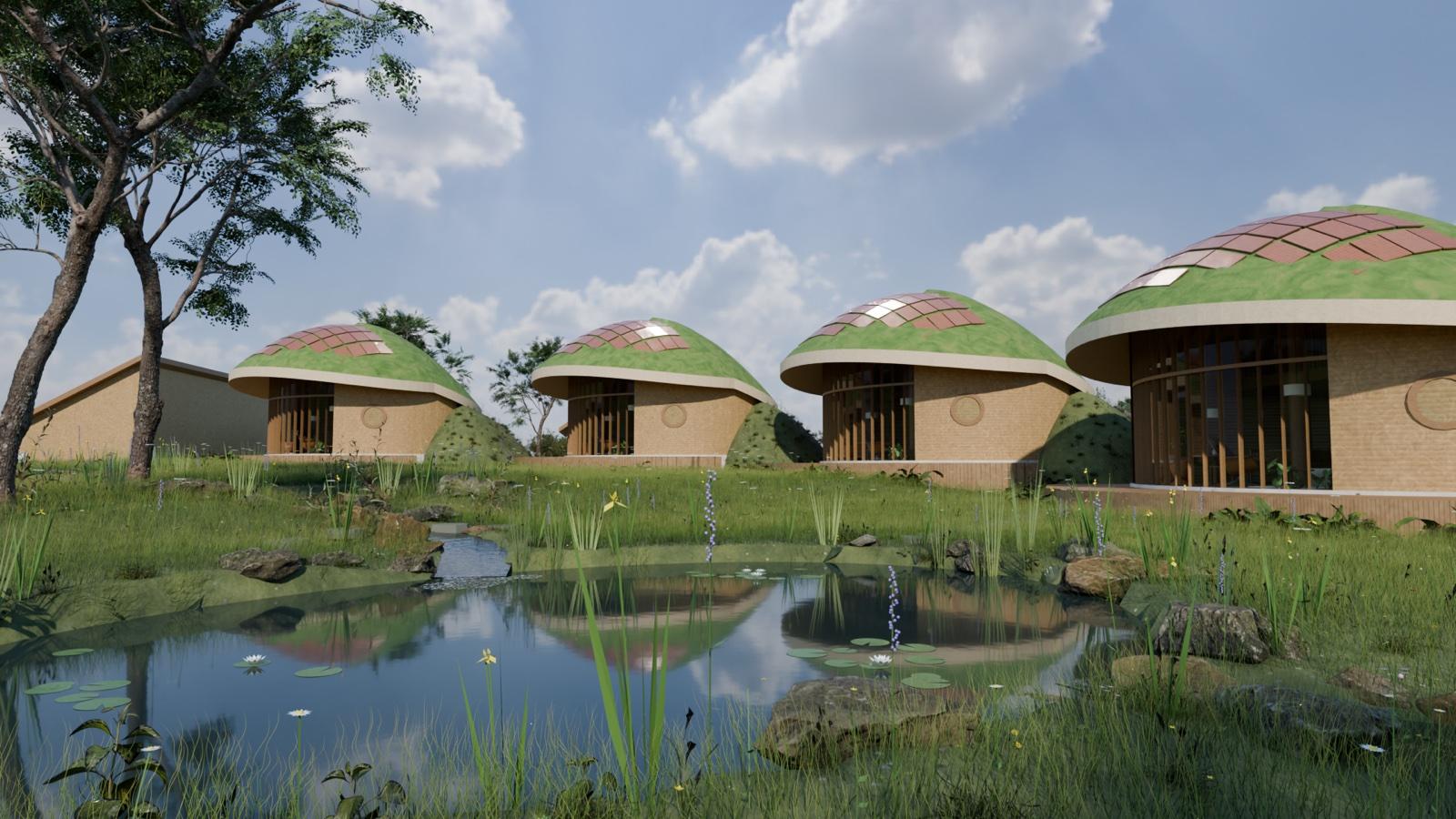
Feeling first, then the maths: eight round houses near Breda
Eight round timber houses of 11 by 9.5 metres around a staircase of ponds near Breda cover 88.4 to 88.5% of their consumption with their own electricity in this lab's model. A row of eight homes for the same households reaches 87.5 to 88.3%. The difference comes from three levers: copper-red panels cost 3.1 to 3.8 percentage points, a solar barn adds 4.9 to 6.1 percentage points, and the round shape itself costs 1.4 percentage points.
A row that added up
Image above: render of the design model, not a photograph.
In this lab I model a neighbourhood of eight houses near Breda that generates almost all of its own electricity. Last week I put that neighbourhood on a real site for the first time: the flank of a stream valley, with real heights, real soil and real groundwater. It is a thought experiment. The land belongs to someone else, and I am not approaching anyone.
The first version was a tidy row. Two blocks of four homes along the slope, on screw piles, with rammed-earth walls and facades of straw and wood. The first sums added up: the foundations, the fire brigade, the water, the energy.
When I saw the picture, my reaction was: this doesn't come anywhere near what I feel. It could have been any new housing estate in the Netherlands.
What carries the feeling
My picture of this neighbourhood is older than the sum. Round timber houses with green roofs, water between the houses, flowers in the grass, copper-red solar panels instead of blue ones. I looked at what carries that feeling, and worked out each part far enough to calculate with it.
- Round and low. Each house is an ellipse of 11 by 9.5 metres. On the north side an earth bank leans against the house, and the green roof runs into it. The house seems to grow out of the hill.
- Glass towards the sun. The eight face south-east to south-south-west, looking at each other across the water.
- A crest with panels. Above the glass the roof curls forward. Wherever the roof does not slope away from the sun, copper-red panels lie on it: 5.3 kWp per house. The overhang keeps out the summer sun.
- Water that steps down. Six shallow ponds sit on the natural steps of the slope, and rainwater from every roof runs into them. Between the lowest two, the water drops about a metre. After rain that happens by itself. For a steady waterfall, a 130-watt pump runs on solar power during summer days. It is in the sum.
- Sharing where possible. A hub and an open solar barn carry 43 kWp between them, facing due south.
Soil, water, fire safety and energy remained the constraints. Only the shape now came from the feeling.
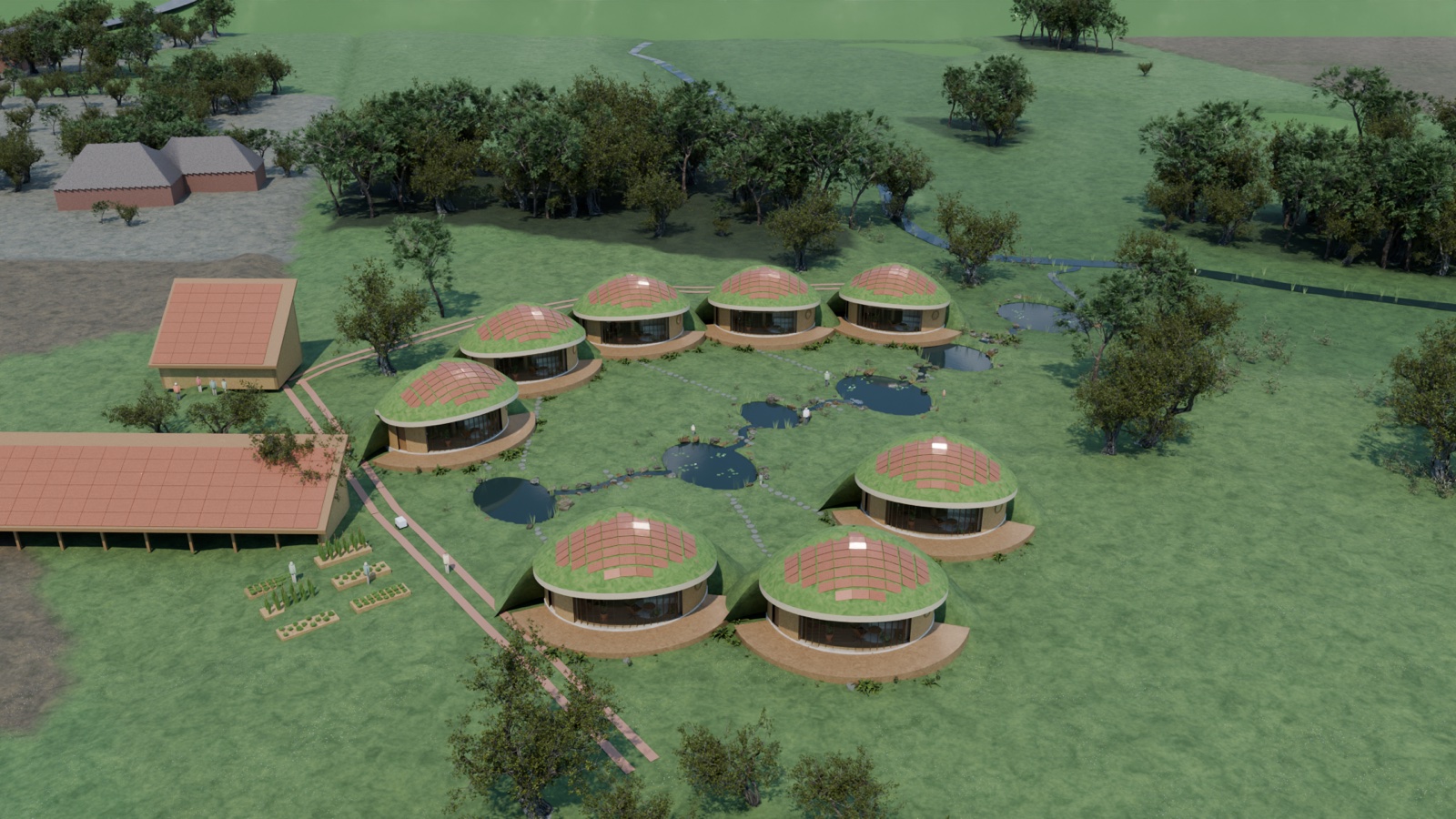
Render of the design model, not a photograph.
Three levers
I ran four neighbourhoods hour by hour, with the same households and the weather of 2018, 2021 and 2022. From one to the next, one thing changes at a time.
| Row | Row, copper-red | Row, copper-red, with barn | Eight round houses | |
|---|---|---|---|---|
| Solar panels | 84 kWp | 69.3 kWp | 96 kWp | 86 kWp |
| Consumption covered by own electricity | 87.5 to 88.3% | 83.7 to 84.9% | 89.8 to 89.9% | 88.4 to 88.5% |
| Per home per year, against the previous column | 420 to 830 euros more | 730 to 1,550 euros cheaper | 290 to 530 euros more |
- Copper-red costs 3.1 to 3.8 percentage points. Coloured panels deliver less per square metre: the same roof holds 6.6 instead of 8 kWp.
- A solar barn adds 4.9 to 6.1 percentage points. An open barn facing due south is the biggest lever.
- The round shape costs 1.4 percentage points. A round roof carries 5.3 kWp per house, a terraced roof with the same panels 6.6. A detached round house with a lot of glass also loses more heat. It is smaller, though: 89 m² inside the facade, against more than 100 m² for a two-storey terraced home.
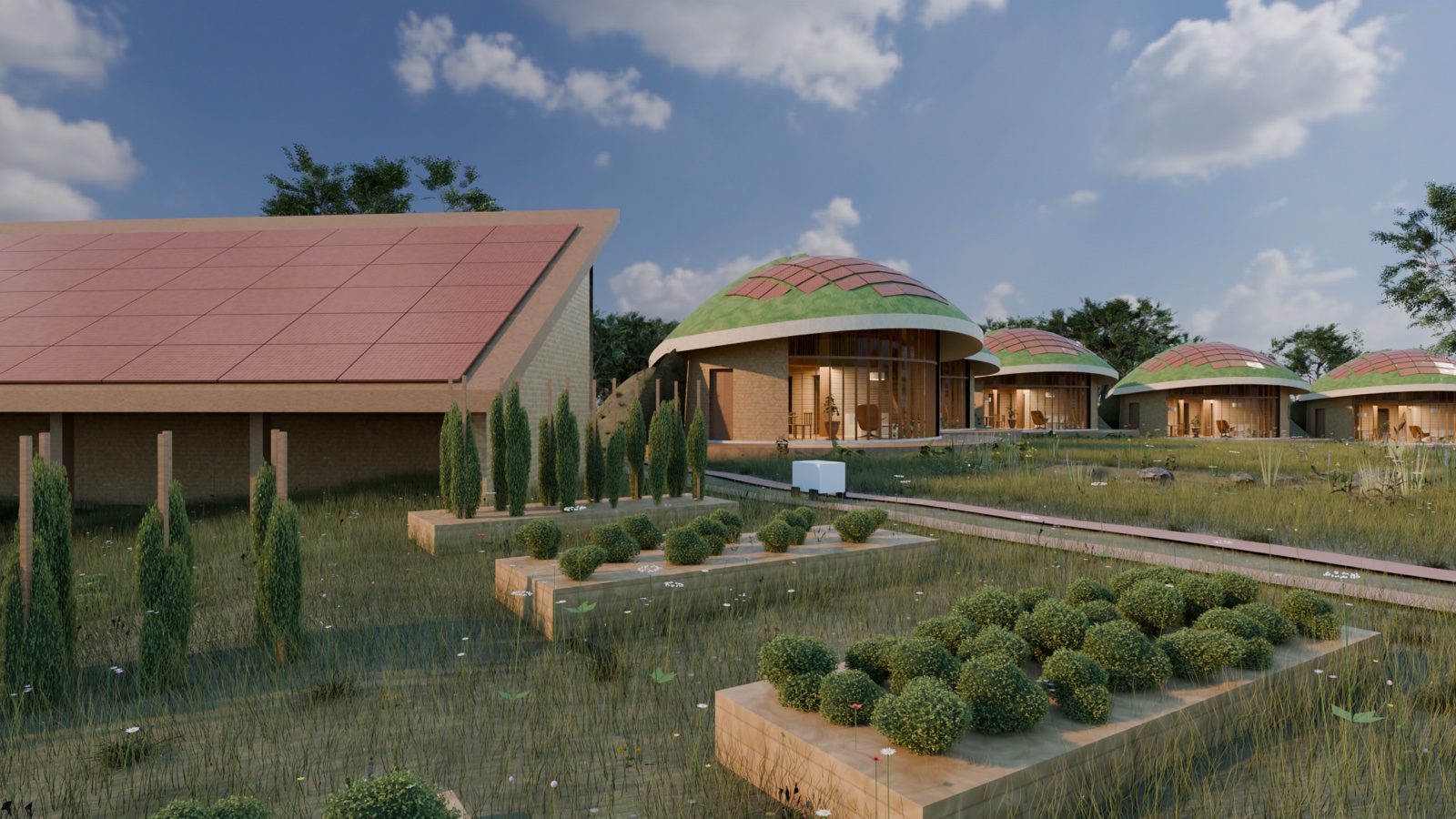
Render of the design model, not a photograph.
The numbers hold in this order. If the barn is already there, copper-red costs only about one percentage point.
Taken together, the round neighbourhood with copper-red panels and a barn reaches slightly more than the row with ordinary panels and no barn. Per home it is 20 to 200 euros a year cheaper.
The amounts are storage, grid and all panels together. I calculate with a control that already knows the whole year's weather, and with that year's electricity prices: in 2022, electricity fed back to the grid paid well. What the barn itself costs, what round timber construction costs extra and what coloured panels cost more per kWp, is not included.
At first it looked different
My first sum had the round neighbourhood winning. I had it checked twice by a second AI model that received the files and the question.
- The first round found three mistakes. I had calculated the panels on the round roof as if they lay on one plane facing south. The gain came from the hub and the barn, which the row did not have. And the storage and the amounts came from a single year, 2022.
- After my fix, the sum blamed the shape for the whole difference. The second round showed that it was mostly the colour of the panels, and a strict rule that covered only the front of the roof.
That is why it now comes in three steps, and why the panels now reach east and west.
The house itself
When I worked out one house in detail, more came up.
- Less house fitted under the round roof than I thought. At 10 by 8.5 metres it had 68 m² of usable floor. Now the houses are 11 by 9.5 metres: 89 m², with two small bedrooms and a loft under the crown.
- At the back, the green roof is up to 54° steep. Twenty centimetres of soil won't stay there, so the thickness follows the slope.
- All 28 rafters meet in a crown under the top of the roof. That crown can float, if the rafters are rigidly fixed to it. Simpler is an oak trunk in the middle of the living room, with the crown on top. That is what the images show now.
- One house stood with its glass facade in a pond. It now stands a few metres further on.
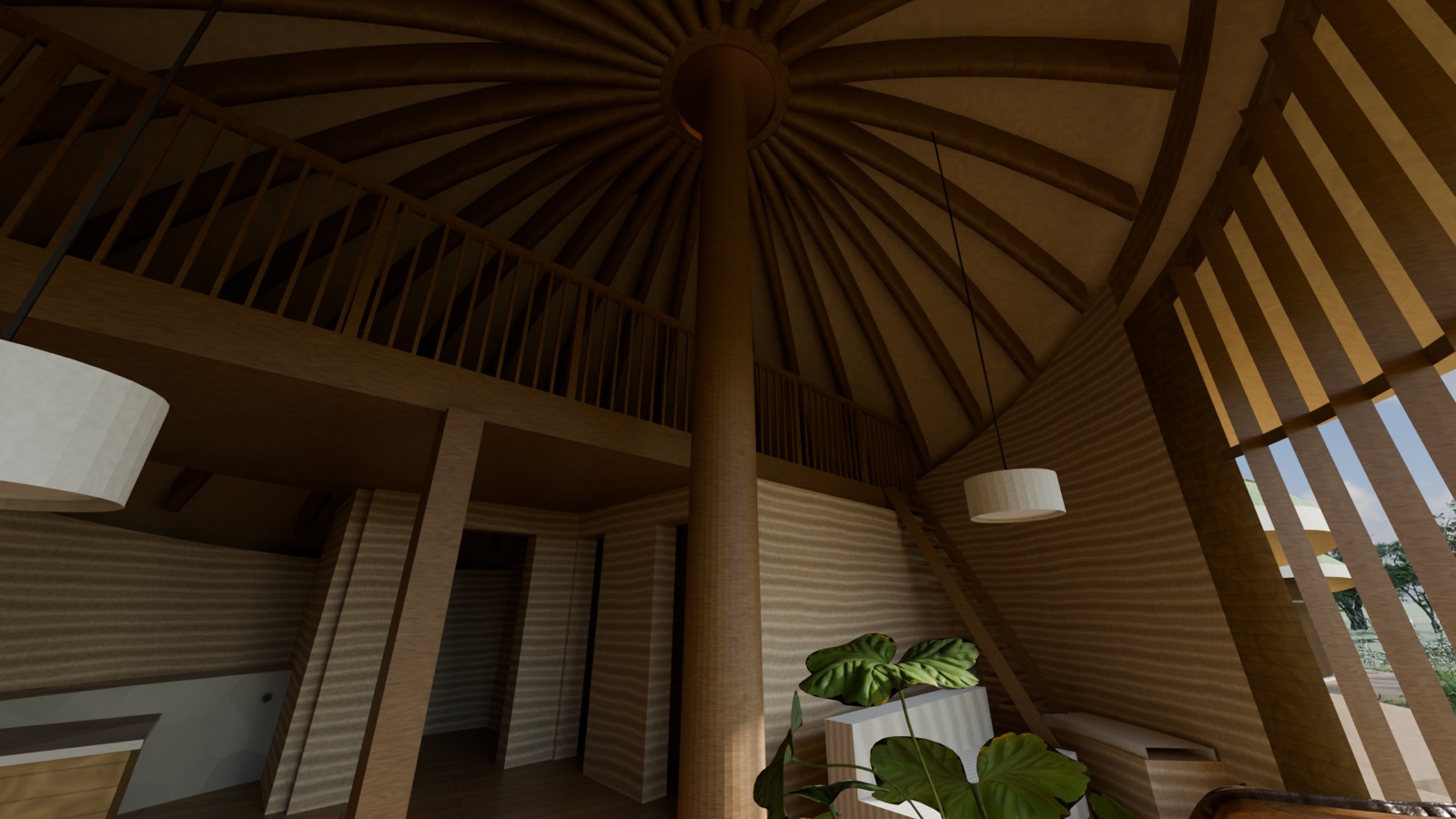
Render of the design model, not a photograph.
I will write about the house itself in a next lab log.
Soul and technology
I believe soul and technology have to go together. If they don't, the thing doesn't live.
The row had only technology. It added up, and it didn't live. The round neighbourhood starts from a feeling, and the sum puts a price next to it: the round shape costs 1.4 percentage points of own electricity and 290 to 530 euros per home per year, the copper-red colour more. A solar barn just about makes up for both. In a few places the picture had to give way to what is actually possible: a thinner layer of green where the roof is steep, a house that moves a few metres.
What the sum says
- Eight round houses around a chain of ponds, with copper-red panels and a solar barn, cover 88.4 to 88.5% of their consumption with their own electricity in the model. A row of eight homes with ordinary panels reaches 87.5 to 88.3%.
- The round shape costs 1.4 percentage points, with the same panels and the same barn.
- Copper-red panels cost 3.1 to 3.8 percentage points.
- A solar barn facing due south adds 4.9 to 6.1 percentage points.
- Those numbers depend on the order: with the barn already in place, copper-red costs about one percentage point.
- What the houses, the barn and the coloured panels cost to build is not yet in the sum.
- This is a sketch design. Structure and foundations still have to go past a structural engineer and a geotechnical adviser.
About the images
The images in this log are renders of the design model in Blender. Terrain, existing trees, houses, ponds and the position of the sun come from open data and from the same sum as the numbers. The panels in the images lie where they lie in the sum.